Compost is a living, breathing organism.
Written by Tiff Horton
Here at The Farm, our vision is to inspire our communities to sustain themselves on nutrient-dense food, cultivated in harmony with nature - and compost plays an essential role in making this vision a reality.
Our nutrient-dense compost is created by utilising organic waste from our on-site restaurant. The compost then returns beneficial microbes and minerals to our soil - the very same soil where our produce is grown, which supplies our on-site restaurant for their seasonal menu.
It’s a beautiful closed loop, zero waste system which is optimised for healthy soil, healthy plants and the health of our community.
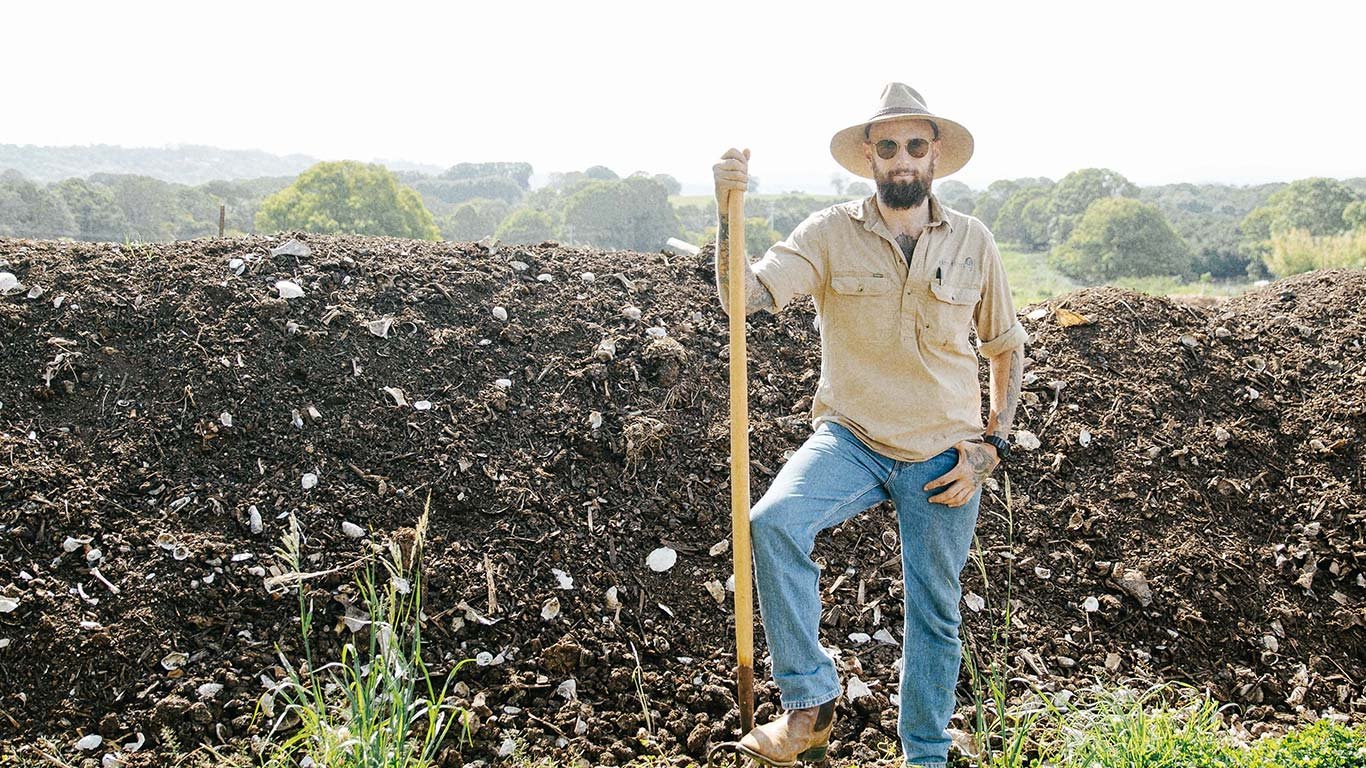
Introducing Ryan Severn, Composting Guru at The Farm
Originally from England, Ryan’s background as a chef led him to cooking in fine dining restaurants across the UK and Australia. Accustomed to working with local, seasonal and great quality ingredients, Ryan spent over a decade in the trade; but eventually the long hours confined indoors, 16 hour shifts and intense workloads started taking their toll on Ryan’s health.
“I was beginning to feel disconnected from the food I was cooking, and I knew I needed a deeper connection to food and nutrition", shares Ryan.
The calling for a healthier lifestyle and paradigm shift reached its pinnacle while Ryan was working as Head Chef of a popular destination restaurant in the Tweed Shire. Ryan stayed in the game long enough to gain permanent residency in Australia, before making the tough decision to step away from his career as a chef.
When the pandemic hit in 2020 and restaurants around the globe closed their doors, Ryan knew it was his opportunity to take the leap into something completely new.
“I had heard about a local organic farm down the road that was more of a live-in education centre, to me this was the perfect opportunity to step into a new life that had been calling out to me for years! ”
Upon joining Conscious Ground as a full-time volunteer, he became immersed in Regenerative Agriculture. It wasn’t long after Ryan’s arrival at Conscious Ground, that their resident compost manager decided to move on; marking the beginning of Ryan’s career in compost.
“This climate attracts a lot of syntropic agroforestry practitioners, and a community who are very conscious of their food choices. If there’s a demand for something, there’s someone ready to create it”.
While working on composting at Conscious Ground, Andy Carbone, The Farm’s General Manager at the time, attended one of Ryan’s talks. Inspired by Ryan’s passion for the craft, Andy was intent on getting Ryan to The Farm to take the lead in Composting.
The seed was planted, and as Ryan’s time at Conscious Ground came to an end, he found himself drawn towards The Farm at Byron Bay.
Of many opportunities on offer at The Farm for continued education in regenerative agriculture, Ryan’s first choice was to begin working with Bunya and Flavia in their permaculture food forest systems. This investment into learning Agroecology set a strong foundation for his future path; and although he was again invited by Andy to implement a composting system for The Farm, he was committed to Agroecology at the time.
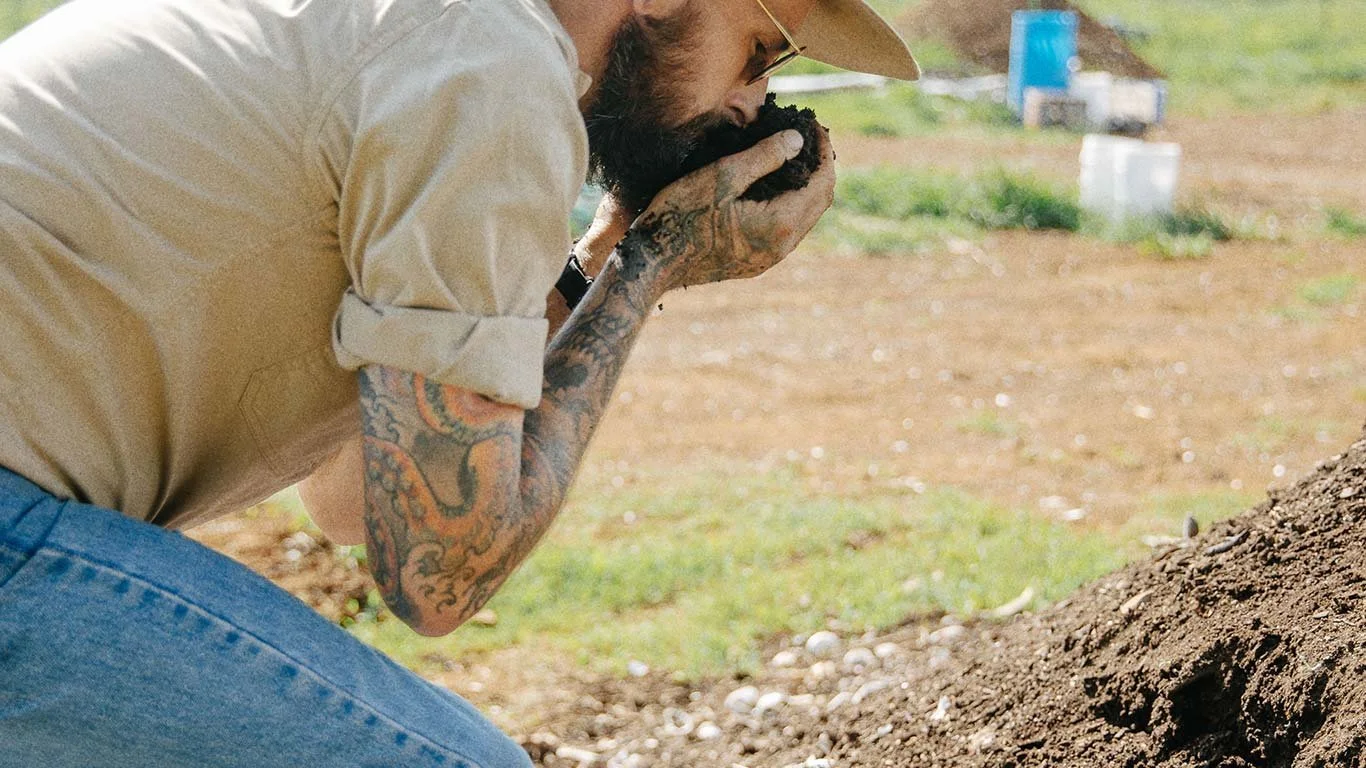
While working in the Food Forest, Ryan heard murmurs of a new type of composting process called SPICE - or “Static Pile Inoculated Compost Extension”.
The more he learned about the SPICE method, the more Ryan felt inspired to get back in the game. It was August of 2022 when Ryan made the move back into composting, and designed and implemented his system at The Farm.
The SPICE Method vs. Hot Compost
Hot composting, also known as the Berkeley Method, is what most people think of when they imagine composting. This style requires a lot of turning and a lot of water. Everything is mixed together, water is added, and the pile is frequently monitored and turned..
In contrast to hot composting, the SPICE method uses 80% less water and energy. It can be thought of as a static, inoculated process, leaning heavily on beneficial facultative microbes as the workforce. Ryan describes the SPICE composting method as somewhere between Bokashi and hot composting.
“It also yields a better quality of compost”, says Ryan. “It's more nutrient dense and it's more of a fermentative process”. Composting requires a delicate balance to ensure the right combination of carbon and nitrogen are present. With any compost, Ryan recommends leaving it to mature at least 6 months, ideally 12 months. He likens it to a fine wine which needs time to develop and mature, creating a more stable and balanced finish.
Food and cafe waste from Three Blue Ducks makes up the entire nitrogen input, while carbon comes from dry brown materials eg. wood chip, dry leaves and coffee chaff. Ryan suggests a basic recipe for composting should follow three parts carbon to one part nitrogen.
At The Farm, organic waste is collected twice a week from the on-site restaurant. The Ducks sort their waste according to specific parameters that work for The Farm’s composting operations. Eggs are kept separate, as is coffee - and pretty much all other food waste is combined together.
“My objective is to deal with food waste in a closed loop system”, says Ryan. “Whereas other composters can be selective about the inputs they use, I’m trying to create a nutrient-dense compost with zero waste”.
“Industry standards say that compost needs to reach 55 degrees celsius in the centre - then you turn it and build it again. I have to do this at least three times until it’s ready - a process that can take up to six months. It took a year before I finally had the system dialled in and my first batch of compost was ready to be used”.
Now approaching the end of its second year, the compost system at the Farm has achieved some incredible results.
Between November 2022 and October 2024, his composting has converted:
10.24 tonnes of coffee grounds and tea leaves
2.28 tonnes of eggshells
1.95 tonnes of harvest waste, grown by our collective of on-site growers
34 tonnes of food waste from the Three Blue Ducks restaurant
That's just shy of 50 tonnes of organic wastes generated on farm that have been successfully diverted from landfill. This process has produced approximately 160 cubic metres of premium compost, which is reintroduced into the soil, supporting the next cycle of crop production in a closed-loop waste management system.
Ryan laughs as he says that Bush Turkeys are great composters, by the way they collect leaf matter and build it into piles of the perfect size to generate enough heat to incubate their eggs.
When asked what he loves about The Farm, Ryan shared, “Working outdoors, being on the land. We’ve got this unique combination of farming, with our shared land and all of the paddocks, plus we have this community - our farm crew, our customers, members of the local community. It’s such a diverse place, it's a stunningly beautiful place to work, and I love the dynamics between land, animals, and people. I can go from being completely alone in the paddock, to being surrounded by a hundred people just moments later”.
What’s next for our Composting Guru?
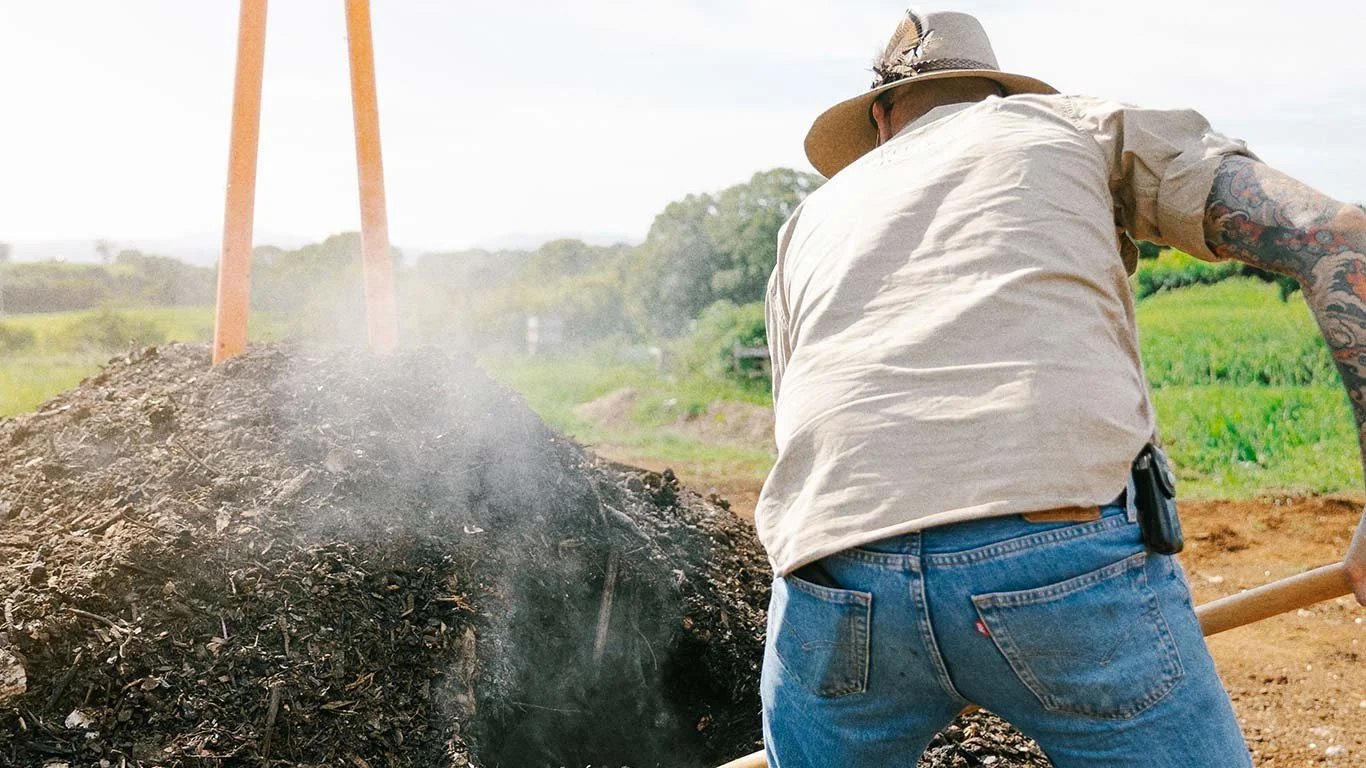
Ryan is very excited to share that he's in the process of setting up a compost extraction system that will enable him to produce liquid soil amendments packed full of the beneficial microbes from his compost. In effect, taking the benefits of compost and extending its efficacy many times over. These extractions are profoundly beneficial to pasture, cropping and orchard systems.
The next time you visit The Farm you may see Ryan in the paddock spraying out one of these extracts as part of his pasture improvement efforts.
Cuts;
While chefing, Ryan had been making his own compost at home, however this role gave him an entirely new perspective.
Ryan observed that Regenerative Agriculture had always been considered quite alternative in the places he’d lived, yet in the Northern Rivers it felt very mainstream
Because it’s more static, we get a higher population of fungus. It works on a biological inoculum, which allows it to be an anaerobic compost so it thrives without oxygen - versus hot compost which needs a lot of oxygen to survive - and thus, is more labour intensive”..
With hot composting there’s an initial heat spike which happens very quickly, and requires the compost to be physically or mechanically turned and rebuilt, putting outside material inside and vice versa, so that the heat dissipates.
This requires the compost to be watered again which becomes very labour intensive - water, oxygen, and temperature are the three variables that need monitoring.
Our compost here at The Farm can get up to 70 degrees celsius (and it can combust occasionally) but our ideal range is 55 degrees. I’m monitoring all our piles regularly to ensure they’re within the ideal thermal band”.
Anaerobic hot compost would usually be putrid - but with the living biological inoculum, it occupies the space before the living bacteria get in.
The SPICE method is also known for keeping more minerals, as less is lost to the environment.
“It's like using a mother in your sourdough and makes the anaerobic process beneficial rather than detrimental”, Ryan shares.
“Any compost is good, and the more biologically dense the better. Smell, texture and colour are good indicators of the quality, although you’d need to get it analysed for biology or look under a microscope to see exactly what’s going in there”.
With a static pile, left unturned for long enough the mycelium will develop, which allows higher fungal content. Anytime compost is moved or turned, it disrupts the mycelium network.
Temperatures are monitored to ensure the compost stays within a healthy temperature range. The heat comes from microbiological activity; the friction of bacterial bodies while feeding that creates the heat.
With a static compost pile it takes longer, usually 12 weeks until the heating phase is finished.
Hot compost can be ready much faster, and will often be turned 10 times in a fortnight.